
The DIY line: small patch or larger job
The EPA treats size as the first sorting rule. Use this table, then check your own situation against it.
| Situation | Usually fine to handle yourself | Call a professional |
|---|---|---|
| Patch size | About 10 square feet or less | Larger than that, or several patches |
| Water source | Leak is fixed and the area is dry | Leak is active or the cause is unknown |
| Material | Painted drywall with a surface patch | Plaster, insulation or sagging drywall |
| Contaminated water | Clean supply water only | Category 2 or 3 water or sewage |
| Your situation | Comfortable using protective gear | Anyone in the home with a health concern should ask a physician first |
Health questions about mold exposure belong with a physician. A restoration crew can speak to the building, not to anyone's health.
What cleaning can do, and what it cannot
Cleaning removes surface growth and the stain it leaves, and on a hard, non-porous surface that can be enough. On painted drywall, plaster and acoustic texture, the picture changes. Those materials are porous, so growth can sit below the surface where a cloth does not reach.
Bleach whitens a stain, which makes the ceiling look clean. It does not fix a damp ceiling or make drywall non-porous. A detergent and water solution, applied sparingly, is the gentler choice for a small patch. Neither one makes the ceiling safe to ignore if the moisture is still there.
That is the honest limit of DIY. You can clean what you can see. You cannot clean what is inside the material.
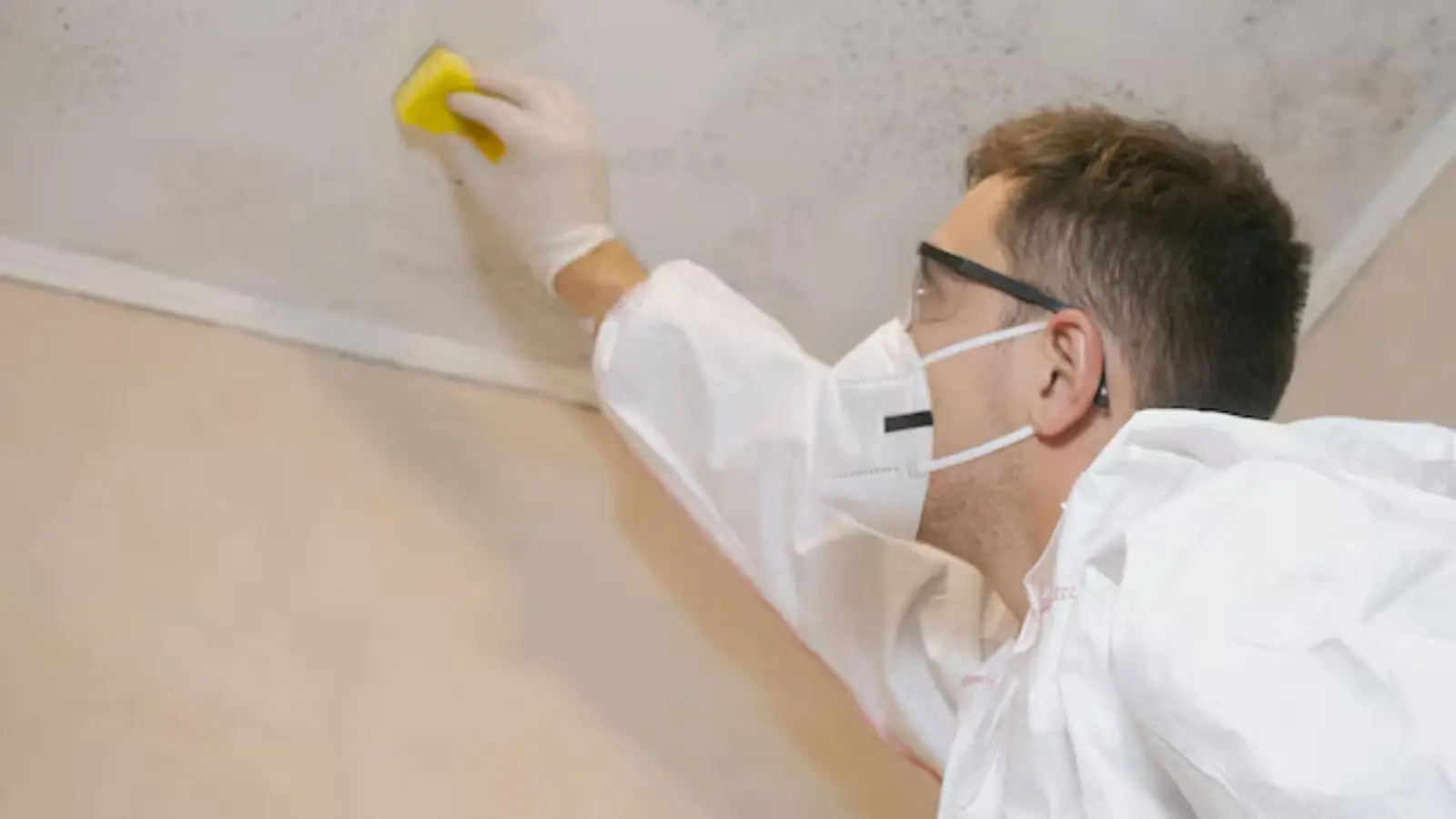
Handling a small patch safely
Follow these steps only if the patch is within the size limit and the leak above it has been repaired.
- Dress for itWear gloves, eye protection and a fitted N95-type respirator. Cover your arms, and open a window if you can.
- Protect the roomLay plastic sheeting under the work area and turn off the HVAC so air does not carry dust through the house.
- Dampen, do not dry-wipeMist the area lightly with detergent and water so spores stay put. Dry brushing sends them airborne.
- Wipe from the edge inUse disposable cloths, working toward the center, and bag each one as you finish.
- Dry the surfaceRun a fan or dehumidifier, then check that the ceiling reads dry. A damp ceiling grows it back.
- Bag and removeSeal the sheeting and cloths in heavy bags and take them out. Watch the spot for weeks.
Ceiling past the DIY line?
Growth spreads while the drywall stays damp. Call (508) 446-9244 and a professional will explain scope and price before work starts.
Why the ceiling is harder than a wall
Ceilings collect warm, humid air, and they hide the plumbing, roof framing and insulation that cause most of the trouble. A ceiling stain is often the last visible sign of a wet cavity above it, so the spot you scrub may be a fraction of the problem.
Gravity adds a second difficulty. Wet drywall sags, and once it holds water it can fail without warning. Even a small patch is worth a gentle test: press lightly with a gloved hand from the side. If it feels soft or gives, stop cleaning and treat it as a material problem, not a surface one.
Work from a stable step ladder, not a chair, and keep your face out of the falling-debris zone. Goggles matter more overhead than anywhere else.
Do not do these
Never mix bleach with ammonia or with other cleaners. Do not sand moldy drywall, do not stand under a sagging ceiling, and do not work near wet light fixtures. If the ceiling bows downward, keep everyone out of the room and call.
When the ceiling material has to come out
Sometimes the right answer is to take the ceiling down. These signs point that way.
- Drywall is soft or crumbling: wet gypsum loses strength, and mold can be growing through the paper face.
- The stain returns after cleaning: moisture or growth remains inside the material.
- Insulation above is wet: it holds water against the ceiling and should be dried or replaced.
- Plaster is bulging or pulling from the lath: the bond has failed, and the surface cannot be saved.
- The patch has grown past the size limit: at that point containment becomes the sensible choice.
In those cases, mold remediation removes the affected material inside containment, and water damage repair puts a new ceiling back once readings are dry.
What the EPA's 10 square foot rule means for your ceiling
The EPA's mold guide says small areas of about 10 square feet or less can often be handled by the homeowner, and that larger areas or significant water damage need more extensive remediation. Ten square feet is roughly a three-by-three-foot patch, about the size of a bath towel unfolded.
The same guide states that "it is impossible to get rid of all mold and mold spores indoors." For a Southbridge homeowner, that matters because the goal is not a sterile ceiling. The goal is to remove visible growth, fix the moisture, and keep the ceiling dry so growth does not restart.
So when you measure, measure honestly. If the stain is near the line, assume it extends beyond what shows, and let a professional check the moisture before you start scrubbing.
Frequently asked questions
Vinegar can clean surface growth on hard surfaces, but like any cleaner, it does not reach into porous drywall or fix the moisture. Use it with the same protective gear and the same size limits.
No one can promise it will not. It depends on whether the moisture is gone. If the ceiling stays dry, growth has little to restart from.
Not always. A small surface patch on a dry, sound ceiling may only need cleaning. Soft, stained-through or repeatedly returning areas usually need the material removed.
Containment, negative air machines with HEPA filtration, removal of affected material, cleaning, drying and verification, following ANSI/IICRC S520. Ask whether the crew works to it.
Ask the Southbridge city offices how construction debris is handled, since this page does not state local disposal rules. Bag it before it leaves the work area.
Only after the area has read dry for a while and the moisture source is fixed. Painting a ceiling that is still damp traps moisture and the stain tends to bleed through. A stain-blocking primer helps with discoloration, but it is not a moisture treatment.